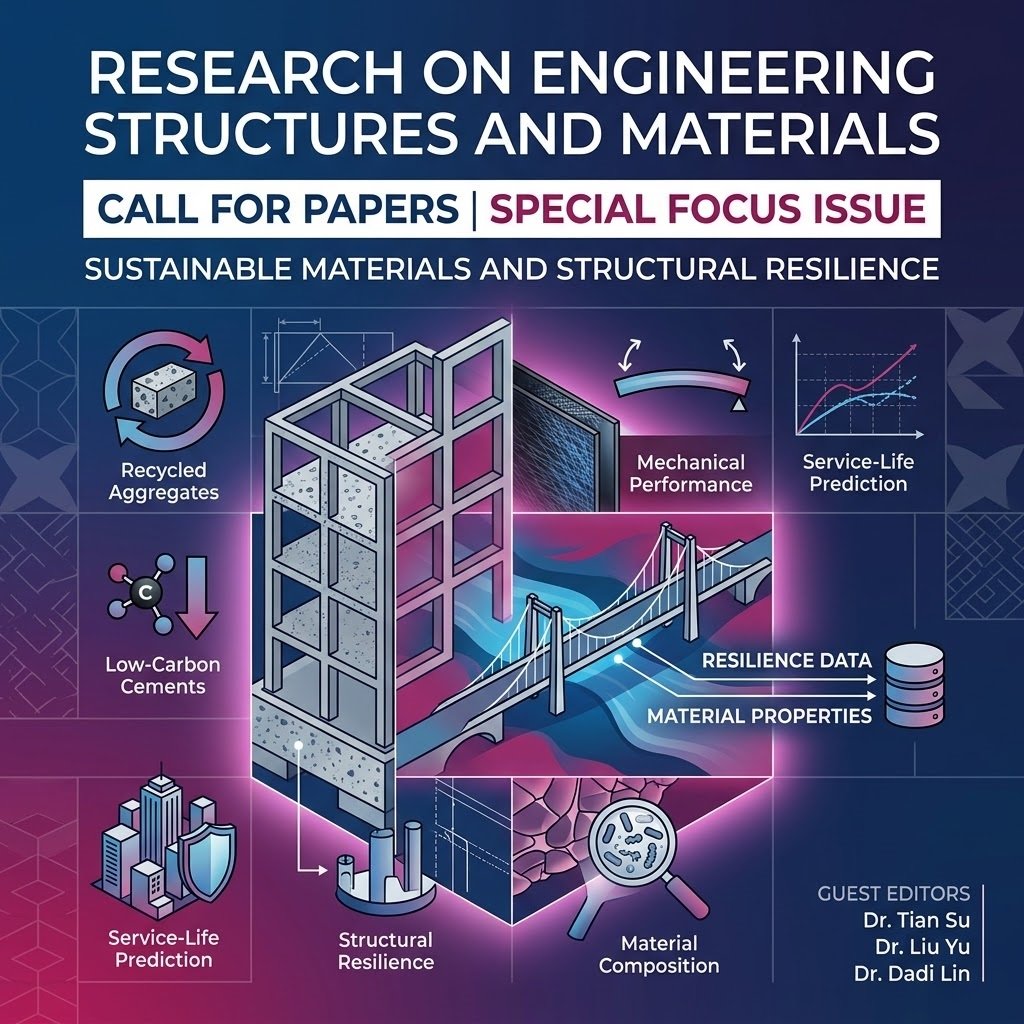
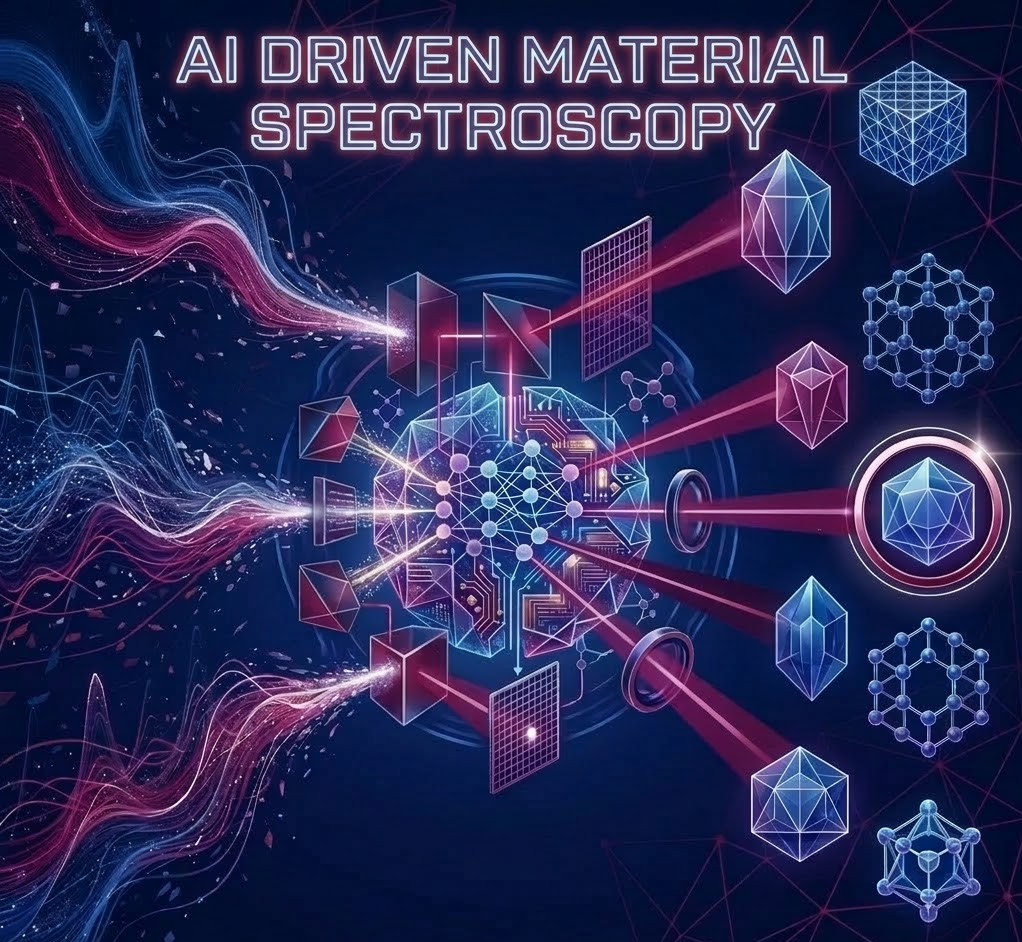
Research on Engineering Structures and Materials (RESM) is pleased to announce a call for papers for our upcoming Special Focus Issue on the critical intersection of machine learning and advanced material characterization.
About the Special Issue
Feature engineering is the process of identifying and classifying key features from unprocessed data so they serve the objectives of machine learning models. It is the crucial skill of selecting essential elements and refining them into characteristics that are relevant and appropriate for advanced computational templates.
For advanced materials like electroceramics, properties and applications depend heavily on the careful manipulation of structure, consistency, and additives. Techniques like impedance spectroscopy, which utilizes the various speed dependences of constituent parts for segregation, provide an effective method for parsing the complexity of these materials.
Recent assessments of laser-induced breakdown spectroscopy (LIBS) systems demonstrate that using alternative feature-engineering and learning-based methods yields highly resilient and reliable identification models. Feature engineering, whether utilizing evolutionary algorithm wavelet changes or analyzing intersecting peaks in multibody frequency spectra, has the potential to vastly improve the accuracy of spectroscopic observations.
From calibrating image spectroscopy data to determining material compositions in nuclear reactor systems, this Special Issue provides an overview of the broad range of organic and inorganic materials that can benefit from feature engineering-enhanced solid-state spectroscopy. By uniquely understanding molecular structures through these enhanced trials, researchers can form robust associations between structure and activity, ultimately aiding in the logical design and advancement of materials.
Topics of Interest
We invite authors to submit original research and review articles. Topics of interest for this Special Issue include, but are not limited to:
-
Evaluation of the global ageing process using luminescence spectroscopy data
-
Materials characterisation using solid-state spectroscopic data improved by variable nuclear polarisation
-
Employing data from field spectroscopy, substrate classification and spectral decision-making
-
Terahertz spectroscopy as a novel instrument for analysing materials and tracking
-
A Novel Method for Individual Component Analysis of Nearly infrared Spectral Data
-
Basic principles and medical uses of infrared spectroscopy and visualisation
-
Synthesis of elements on evaluation of data from gamma ray spectroscopy
-
Utilising mass spectrometry and computer assessment, categorised and detection
-
Structural imperfection characterization in metallic components using positron extinction spectroscopy
-
Characterization of eumelanins and pheomelanins using electron spun magnetic spectroscopy
-
Analyzing pellets parametrically for atomic structure using laser-induced dissolution spectroscopy
Guest Editorial Board
Managing Guest Editor:
-
Dr. Mitchai Chongcheawchamnan Faculty of Engineering, Prince of Songkhla University, Songkhla, Thailand
Co-Editors:
-
Dr. Nutapong Somjit School of Electronic and Electrical Engineering, University of Leeds, Leeds, England.
-
Dr. Anirban Tarafdar Department of Data Science and Engineering, IISER Bhopal, Bhopal, India.
Submission Details
📌 Now Open for Submissions
📌 Submission Deadline: August 15, 2026
📌 Submission Instructions: Authors should select the section titled “SFI: AI Spectroscopy” when uploading their manuscript through the journal’s submission system.