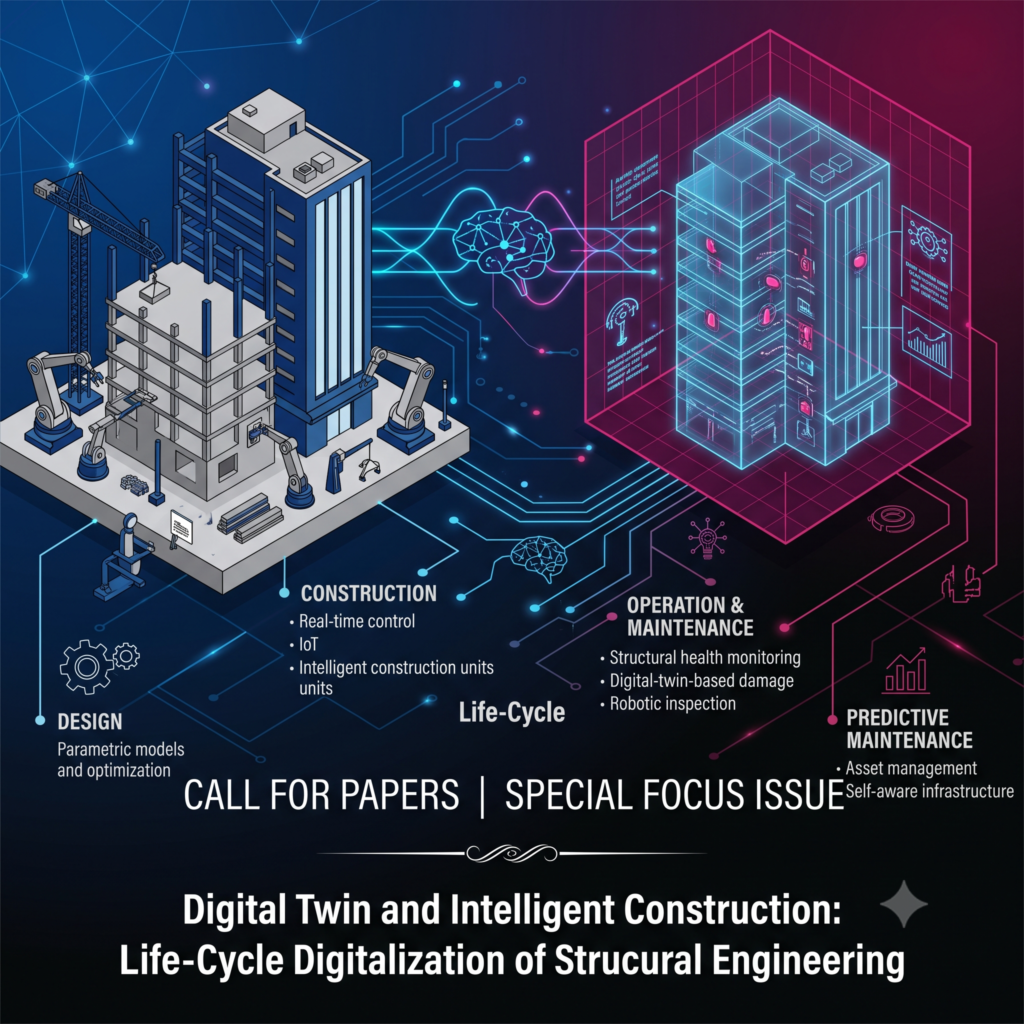
Accurate carbon emission accounting and predictive analysis across the building lifecycle are critical for sustainable infrastructure management and smart city policymaking. However, conventional prediction models often suffer from low interpretability and insufficient integration with dynamic construction processes. This study proposes a digital twin-oriented framework that synergizes a domain-specific Knowledge Graph (KG) with a hybrid deep learning architecture, leveraging multi-source heterogeneous data including BIM, IoT sensor streams, and operational logs. A spatiotemporal KG encodes semantic relationships among building components, energy flows, and onsite activities. This KG is integrated with a Graph Convolutional Network–Temporal Convolutional Network (TCN-GCN) to capture spatial dependencies and temporal evolution patterns of carbon emissions, enabling real-time predictive analytics within a digital twin environment. The multi-source data input comprises BIM models, IoT sensor streams, and operational logs from a 12-month deployment in a Shanghai green building demonstration project, supplemented by the Global Infrastructure Emissions Database. The project is a public office building of approximately 20,000 m², equipped with a central HVAC system, a building automation system, and over 80 IoT submeters. The data span from January 2025 to December 2025, with sensor data sampled at 15-minute intervals and aligned to hourly timestamps. The framework enhances prediction accuracy and provides interpretable semantic support for emission traceability and scenario-based retrofitting decisions. Experimental results show that for entity and relation extraction in KG construction, the proposed method achieves 99.8% accuracy and 98.5% recall, with an F1-score of 0.95. The dataset was partitioned strictly by project to prevent data leakage.